Problem:
다음은 색의 3요소인 red, green, blue로 색을 추상화한 Color 클래스를 선언하고 활용하는 코드이다. 빈칸을 채워라.
red, green, blue는 0~255의 값만 가진다.
|
|
| 1 2 3 4 5 6 7 8 9 10 11 12 13 14 15 16 17 18 19 20 21 22 23 24 25 26 27 28 29 30 31 |
#include using namespace std; class Color { int red, green, blue; public: Color() {red = green = blue = 0;} Color(int r, int g, int b) {red = r; green = g; blue = b;} void setColor(int r, int g, int b) {red = r; green = g; blue = b;} void show() {cout << red << ' ' << green << ' ' << blue << endl;} }; int main() { Color screenColor(255,0,0); // 빨간색의 screenColor 객체 생성 Color *p; // Color 타입의 포인터 변수 p 선언 _____ // (1) p가 screenColor의 주소를 가지도록 코드 작성 _____ // (2) p와 show()를 이용하여 screenColor 색 출력 _____ // (3) Color의 일차원 배열 colors 선언. 원소는 3개 _____ // (4) p가 colors 배열을 가리키도록 코드 작성 // (5) p와 setColor()를 이용하여 colors[0], colors[1], colors[2]가 // 각각 빨강, 초록, 파랑색을 가지도록 코드 작성 _____ _____ _____ // (6) p와 show()를 이용하여 colors 배열의 모든 객체의 색 출력. for 문 이용 _____ _____ _____ } |
Objective & Hints:
객체 포인터와 객체 배열 활용
Execution Result:
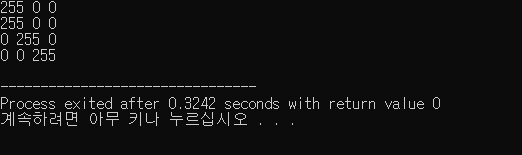
Code:
|
|
| 1 2 3 4 5 6 7 8 9 10 11 12 13 14 15 16 17 18 19 20 21 22 23 24 25 26 27 28 29 30 31 |
#include using namespace std; class Color { int red, green, blue; public: Color() {red = green = blue = 0;} Color(int r, int g, int b) {red = r; green = g; blue = b;} void setColor(int r, int g, int b) {red = r; green = g; blue = b;} void show() {cout << red << ' ' << green << ' ' << blue << endl;} }; int main() { Color screenColor(255,0,0); // 빨간색의 screenColor 객체 생성 Color *p; // Color 타입의 포인터 변수 p 선언 p = &screenColor; // (1) p가 screenColor의 주소를 가지도록 코드 작성 p->show(); // (2) p와 show()를 이용하여 screenColor 색 출력 Color colors[3]; // (3) Color의 일차원 배열 colors 선언. 원소는 3개 p = colors; // (4) p가 colors 배열을 가리키도록 코드 작성 // (5) p와 setColor()를 이용하여 colors[0], colors[1], colors[2]가 // 각각 빨강, 초록, 파랑색을 가지도록 코드 작성 p[0].setColor(255,0,0); p[1].setColor(0,255,0); p[2].setColor(0,0,255); // (6) p와 show()를 이용하여 colors 배열의 모든 객체의 색 출력. for 문 이용 for(int i=0; i<3; i++){ p[i].show(); } } |
Explanation:
객체 포인터와 객체 배열의 사용법을 익히는 문제입니다.
클래스 타입의 포인터 변수가 같은 클래스 타입의 객체의 주소를 가지도록 한 후,
화살표 연산자(->)를 이용하여 클래스 멤버를 호출할 수 있습니다.